Anatomy of HDFS File Read and Write

I am a Tech Enthusiast having 13+ years of experience in 𝐈𝐓 as a 𝐂𝐨𝐧𝐬𝐮𝐥𝐭𝐚𝐧𝐭, 𝐂𝐨𝐫𝐩𝐨𝐫𝐚𝐭𝐞 𝐓𝐫𝐚𝐢𝐧𝐞𝐫, 𝐌𝐞𝐧𝐭𝐨𝐫, with 12+ years in training and mentoring in 𝐒𝐨𝐟𝐭𝐰𝐚𝐫𝐞 𝐄𝐧𝐠𝐢𝐧𝐞𝐞𝐫𝐢𝐧𝐠, 𝐃𝐚𝐭𝐚 𝐄𝐧𝐠𝐢𝐧𝐞𝐞𝐫𝐢𝐧𝐠, 𝐓𝐞𝐬𝐭 𝐀𝐮𝐭𝐨𝐦𝐚𝐭𝐢𝐨𝐧 𝐚𝐧𝐝 𝐃𝐚𝐭𝐚 𝐒𝐜𝐢𝐞𝐧𝐜𝐞. I have 𝒕𝒓𝒂𝒊𝒏𝒆𝒅 𝒎𝒐𝒓𝒆 𝒕𝒉𝒂𝒏 10,000+ 𝑰𝑻 𝑷𝒓𝒐𝒇𝒆𝒔𝒔𝒊𝒐𝒏𝒂𝒍𝒔 and 𝒄𝒐𝒏𝒅𝒖𝒄𝒕𝒆𝒅 𝒎𝒐𝒓𝒆 𝒕𝒉𝒂𝒏 500+ 𝒕𝒓𝒂𝒊𝒏𝒊𝒏𝒈 𝒔𝒆𝒔𝒔𝒊𝒐𝒏𝒔 in the areas of 𝐒𝐨𝐟𝐭𝐰𝐚𝐫𝐞 𝐃𝐞𝐯𝐞𝐥𝐨𝐩𝐦𝐞𝐧𝐭, 𝐃𝐚𝐭𝐚 𝐄𝐧𝐠𝐢𝐧𝐞𝐞𝐫𝐢𝐧𝐠, 𝐂𝐥𝐨𝐮𝐝, 𝐃𝐚𝐭𝐚 𝐀𝐧𝐚𝐥𝐲𝐬𝐢𝐬, 𝐃𝐚𝐭𝐚 𝐕𝐢𝐬𝐮𝐚𝐥𝐢𝐳𝐚𝐭𝐢𝐨𝐧𝐬, 𝐀𝐫𝐭𝐢𝐟𝐢𝐜𝐢𝐚𝐥 𝐈𝐧𝐭𝐞𝐥𝐥𝐢𝐠𝐞𝐧𝐜𝐞 𝐚𝐧𝐝 𝐌𝐚𝐜𝐡𝐢𝐧𝐞 𝐋𝐞𝐚𝐫𝐧𝐢𝐧𝐠. I am interested in 𝐰𝐫𝐢𝐭𝐢𝐧𝐠 𝐛𝐥𝐨𝐠𝐬, 𝐬𝐡𝐚𝐫𝐢𝐧𝐠 𝐭𝐞𝐜𝐡𝐧𝐢𝐜𝐚𝐥 𝐤𝐧𝐨𝐰𝐥𝐞𝐝𝐠𝐞, 𝐬𝐨𝐥𝐯𝐢𝐧𝐠 𝐭𝐞𝐜𝐡𝐧𝐢𝐜𝐚𝐥 𝐢𝐬𝐬𝐮𝐞𝐬, 𝐫𝐞𝐚𝐝𝐢𝐧𝐠 𝐚𝐧𝐝 𝐥𝐞𝐚𝐫𝐧𝐢𝐧𝐠 new subjects.
HDFS has a master and slave kind of architecture. Namenode acts as master and Datanodes as worker. All the metadata information is with namenode and the original data is stored on the datanodes. Keeping all these in mind the below figure will give idea about how data flow happens between the Client interacting with HDFS, i.e. the Namenode and the Datanodes.
Anatomy of File Read
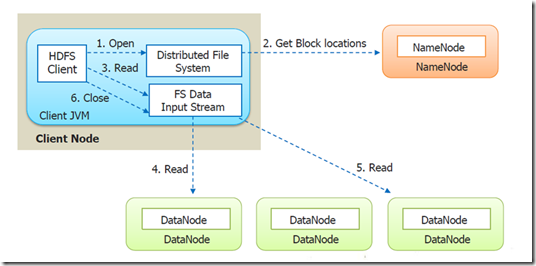
The following steps are involved in reading the file from HDFS:
Let’s suppose a Client (a HDFS Client) wants to read a file from HDFS.
Step 1: First the Client will open the file by giving a call to open() method on FileSystem object, which for HDFS is an instance of DistributedFileSystem class.
Step 2: DistributedFileSystem calls the Namenode, using RPC (Remote Procedure Call), to determine the locations of the blocks for the first few blocks of the file. For each block, the NameNode returns the addresses of all the DataNode's that have a copy of that block. Client will interact with respective DataNode'sto read the file. NameNode also provide a token to the client which it shows to data node for authentication.
The DistributedFileSystem returns an object of FSDataInputStream(an input stream that supports file seeks) to the client for it to read data from FSDataInputStream in turn wraps a DFSInputStream, which manages the datanode and namenode I/O
Step 3: The client then calls read() on the stream. DFSInputStream, which has stored the DataNode addresses for the first few blocks in the file, then connects to the first closest DataNode for the first block in the file.
Step 4: Data is streamed from the DataNode back to the client, which calls read() repeatedly on the stream.
Step 5: When the end of the block is reached, DFSInputStream will close the connection to the DataNode , then find the best DataNode for the next block. This happens transparently to the client, which from its point of view is just reading a continuous stream.
Step 6: Blocks are read in order, with the DFSInputStream opening new connections to datanodes as the client reads through the stream. It will also call the namnode to retrieve the datanode locations for the next batch of blocks as needed. When the client has finished reading, it calls close() on the FSDataInputStream.
Anatomy of File Write
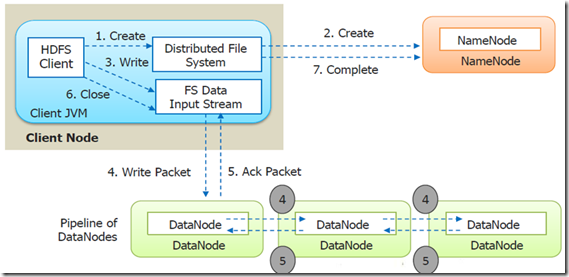
Step 1: The client creates the file by calling create() method on DistributedFileSystem.
Step 2: DistributedFileSystem makes an RPC call to the namenode to create a new file in the filesystem’s namespace, with no blocks associated with it.
The namenode performs various checks to make sure the file doesn’t already exist and that the client has the right permissions to create the file. If these checks pass, the namenode makes a record of the new file; otherwise, file creation fails and the client is thrown an IOException. TheDistributedFileSystem returns an FSDataOutputStream for the client to start writing data to.
Step 3: As the client writes data, DFSOutputStream splits it into packets, which it writes to an internal queue, called the data queue. The data queue is consumed by the DataStreamer, which is responsible for asking the namenode to allocate new blocks by picking a list of suitable datanodes to store the replicas. The list of datanodes forms a pipeline, and here we’ll assume the replication level is three, so there are three nodes in the pipeline. TheDataStreamer streams the packets to the first datanode in the pipeline, which stores the packet and forwards it to the second datanode in the pipeline.
Step 4: Similarly, the second datanode stores the packet and forwards it to the third (and last) datanode in the pipeline.
Step 5: DFSOutputStream also maintains an internal queue of packets that are waiting to be acknowledged by datanodes, called the ack queue. A packet is removed from the ack queue only when it has been acknowledged by all the datanodes in the pipeline.
Step 6: When the client has finished writing data, it calls close() on the stream.
This action flushes all the remaining packets to the datanode pipeline and waits for acknowledgments before contacting the namenode to signal that the file is complete The namenode already knows which blocks the file is made up of , so it only has to wait for blocks to be minimally replicated before returning successfully.


